Showing posts with label Food Stories. Show all posts

Saturday, 23 January 2010

Life in Fès: A Walk in the Atlas

I'm ashamed of this, but I posted this on my French blog more than one month ago; and I'm even more ashamed to say that I considered not translating it, just posting the pictures (lazy me). But finally, I don't know how (I'm so tired of the computer because I've been working on it 10 hours a day - new, exciting job!), I managed to do it. So here you are.

Sometimes, I'd rather be somewhere else; go far away, see new places, speak other languages.

For me, right now, this isn't possible. Too much work.

And when I leave Fez, it's to go to Casablanca or Rabat - not the best places to relax.

So, I just take a walk in the Atlas, a neighborhood in Fez, in the Ville Nouvelle. It costs nothing, and it's just a few minutes from my apartment.

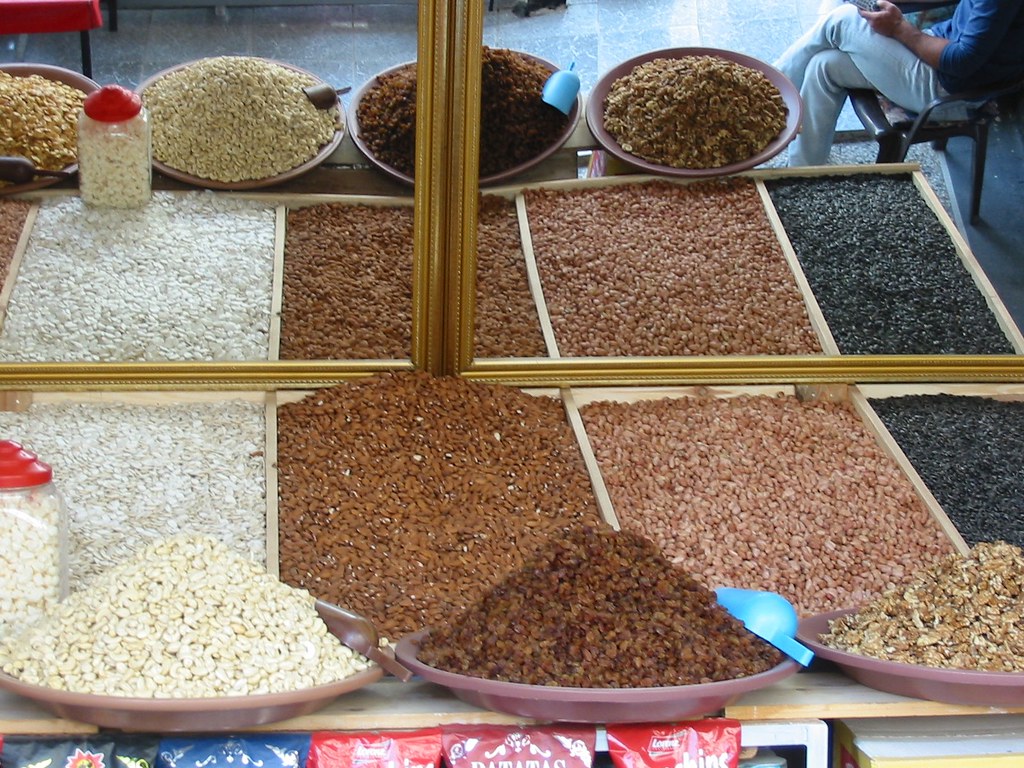
It's one of my favorite places in Fez. It's popular, lively, and colorful - and it's the place to go for food, with a lot of small restaurants, and all kinds of stores.


Quartier de l'Atlas, Fès

Quartier de l'Atlas, Fès

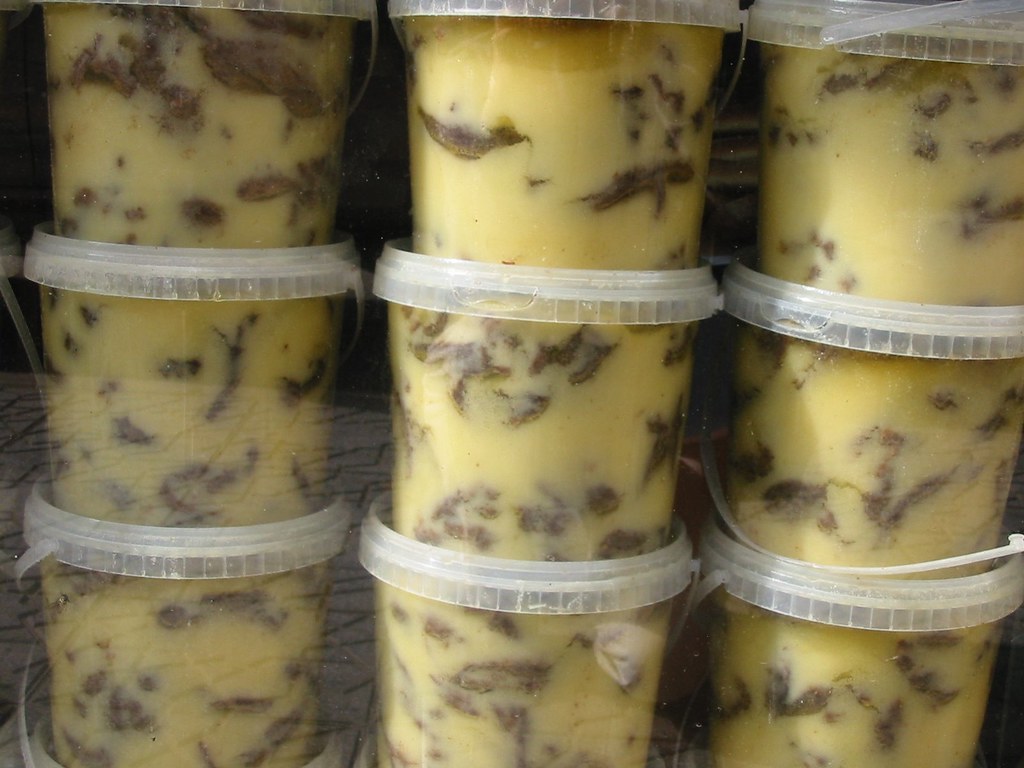
On the next photo, you can see buckets of khlie, dried beef, preserved in fat. It's delicious, and quite expensive.

Quartier de l'Atlas, Fès

L'Atlas, Fès

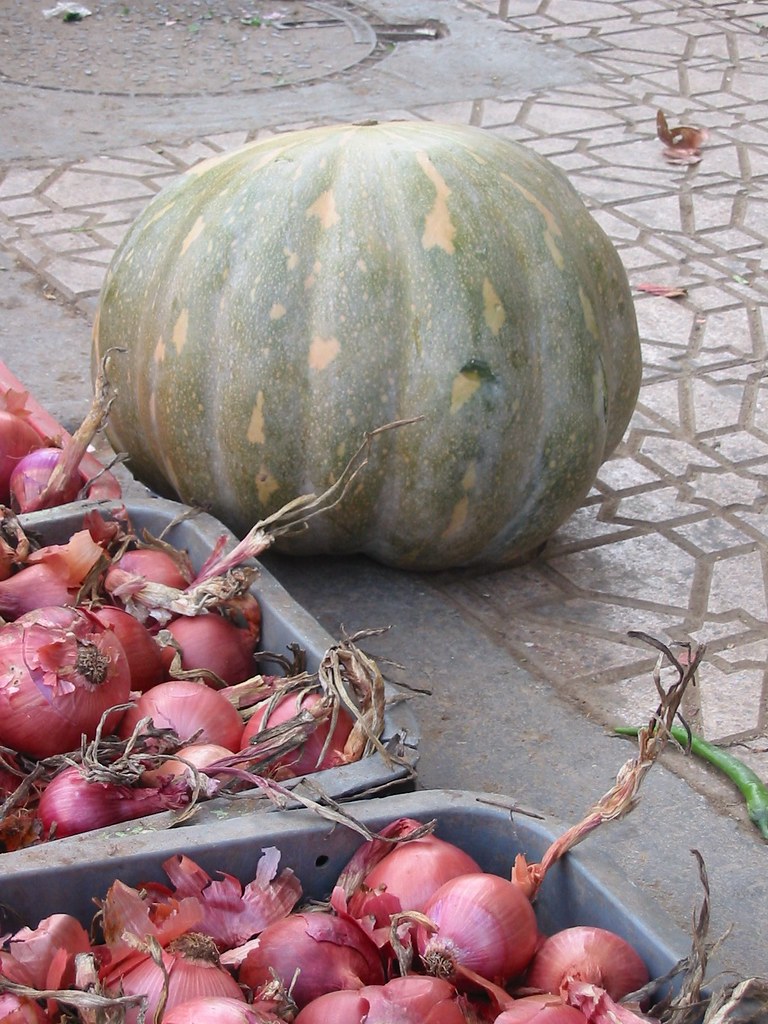
(it's often hard to take pictures in the street in Morocco. You need to ask people for their permission - well, I guess you don't need to, but it's more polite. Most people agree, but sometimes not, like this guy who was selling vegetables. He got quite angry actually. But too late, I had stolen that photo).

Quartier de l'Atlas, Fès

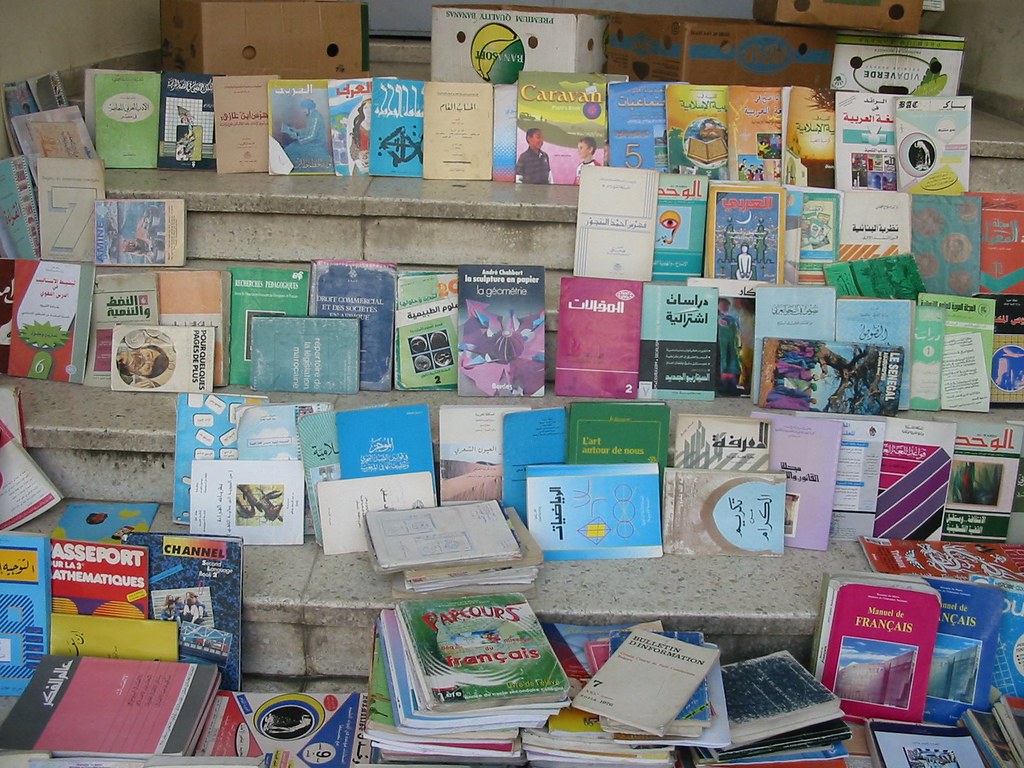
Just by the CTM (the national bus compagny), there is an old man who sells used books. I sometimes buy European magazines from him, for 5 dirhams.

Quartier de l'Atlas, Fès


Quartier de l'Atlas, Fès


Quartier de l'Atlas, Fès


Quartier de l'Atlas, Fès


Quartier de l'Atlas, Fès

Wednesday, 9 July 2008

Caper Season in Morocco

For than 10 days now, it’s been more than 40° c. in the countryside. From time to time the Chergui, the hot wind coming from the Sahara desert, blows and makes all attempt of leaving the house very difficult.

Fortunately, the straw and the earth of our mudbrick house are very insulating. It’s easier to fall asleep in our house than in an appartment in Fez, because it keeps us cool.

Our garden suffers because of that crazy heat. In spite of our water tank and our water-treatment ponds, we’re running out of water. The ponds are empty, it’s so hot that the water evaporate instantly.

Only one plant seems to be adapted to this climate.


Caper trees do nothing like the other plants here and grow at the moment when everything else dies. Once the wheat harvest is over, small shrubs appear in the fields, and grow bigger every week. It seems that the less water there is, the more caper trees are happy.

Oddly enough, the caper trees grow in parallel lines, as if they had been planted by man – which had been maybe the case, a long time ago.

The inhabitants of Ouled Mgatel benefit from this indestructible plant. They don’t eat it though.


Our neighbors gather the capers


Caper trees make new caper every week. But do you know what are capers anyway ? They are not the fruit of the caper tree, but its flower buds. The flowers are beautiful, and they have a very nice fragrance.
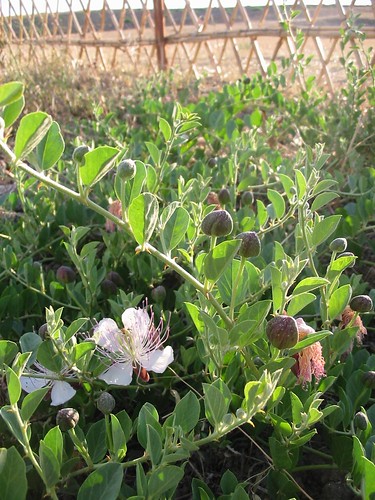


People here gather the capers when they are big, much bigger than we’re used to see them in the jar in the European supermarket. Then the capers are sold at the market. This year, peasants get 15 dirhams (1,40 euro) for a kilogram of caper. Then, the capers of Ouled Mgatel (and of the all area of course !) begin their trip around the world; they are sold in China. There, it seems, people like big capers.

Believe me, capers are hard to pick, mainly because of the big thorns. Plus, they are only a few capers on each branch, which makes for a long picking. And the picking has to be done every week.

I really wanted to pick some, because I had this idea of jars of capers in my cupboard, and pizzas, and pastas… Well, I certainly was too confident. And I gave up, after 20 minutes of painful picking. Here is my (bad) harvest :
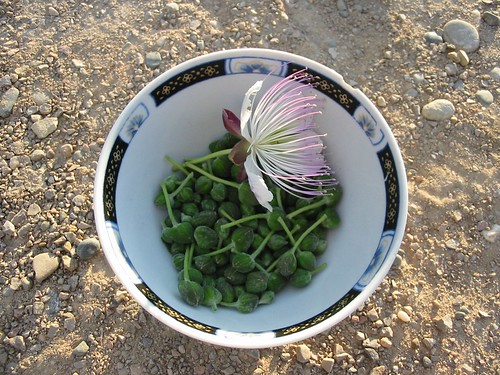

Yeah, I know, it’s disappointing, even if, contrary to my neighbors, I only picked the small ones, that is, the ones closer to the thorns…

I put my meager harvest in a jar, with a mixture of vinegar, salt, and water, but I won’t give you the recipe before I try to eat it !

Tuesday, 26 February 2008

Making Olive Oil

The neighbors invited us for lunch. We were sitting on the bench, waiting for the potatoes tajine and the eggs the women prepared for us, when Mohammed came in the room, all covered with some black and sticky substance. He told us that it was olives, so we got back to our house, got the camera, and there we were, taking dozens of photographs of the mill, of the workers, and of the mule.

Mohammed's farm

We took these photographs before the rain... it explains the wonderful sun on the pics.

The mill

Mohammed uses his mill for his own olives, but he also leases it to other farmers. That was the case that day.
The olives were harvested in November. Then they were put in big bags with some salt. Apparently, they can wait there as long as you want, they can be any time.

1. The mule grinds the olives.


Let's go ! Watch it !


2. The olives are squeezed

The olive puree is put in some kind of bags made of rush, which are piled on the press.

The press. A glass of tea is hidden in the picture...

Of course the boss is in charge !

It's the third time that these olives are pressed, so they need boiling water to give all their oil.


That photo of the oil coming out of the rush bags is kind of creepy... that 's because of the flash I think. But be reassured, the oil is really delicious, Mohammed even drank a glass of it to show us how good it is...
Did you find it?

Outside the mill, just the fields, and a pile of feytor

Later, Mohammed will sell the feytor, the residue of the olives. It is a very good combustible.

Sunday, 24 February 2008

We won't go hungry (2)

The neighbors treat us every day... Bread, vegetables, and hot tajines... How lucky we are ! Last week, we had:

- a wonderful dish, but we forgot how it's called... It made with couscous, a herb called mallow (baqula in Moroccan Arabic), and olive oil.


- some couscous, that had been prepared in great quantity that day. A young boy in a village a few miles away from here died, and our neighbor Mohammed paid a visit to his grieving family. The custom, in that case, is to bring along vegetables and couscous, to help the family, that receives numerous visitors, and has to feed them all.


- finally, 15 pounds of green peas, brought by a man we didn't know, and who has been welcomed very loudly and aggressively by the dogs... He turned out the son of a man we once gave a ride to Fez, and who wanted to thank us.

Yep, 15 pounds of green peas to shell !

Thursday, 14 February 2008

Sardine Tajine

Last week, Bachir asked us to bring some sardines from Fez. But we forgot. So, since we were at the souk on Tuesday, we bought some. The fish, from Al Hoceima, on the Mediterranean coast, was very fresh.
And then, between the construction of a door and , Bachir made us a tajine.

The workers/keepers/cooks at work

I have to reassure you, it's true that Fouad's jacket seems very dirty - well, actually it is, since a few seconds before the photograph was taken he was doing this:


Fouad, preparing the adobe coating with water,
a special kind of earth, and straw


Anyway, the dish was very good, and very easy to make. Once you put the dish on the fire, don't touch it, it cooks by its own and doesn't need to be stirred.


Sardine Tajine
Serves 4

2 pounds of sardines, scaled and cleaned
3 tomatoes, cut in thin layers
2 red onions, in thin layers
3 big potatoes, in thin layers
1 lemon
1 bunch of coriander
1 bunch of parsley
1 tablespoon of olive oil
2 tablespoons of some other kind of oil, neutral
Salt
1 teaspoon of hot chili powder
1 teaspoon of cumin
1 tajine dish


To begin with, put the sardines fillets in the tajine dish. Add the grinded coriander, the spices and the salt, and then mix all of this using your hands.


Then place half of the potates under the fish.

Put the vegetables on the sardines, in that order: the rest of the potatoes, the tomatoes and the onions.
Then place the bunch of parley on top of the vegetables. Add the lemon juice, the oils, and a glass of water.


Close the tajine, and put it on the burner. When it's hot, reduce the heat to a minimum. Let it cook for 2 hours. Don't forget to check on the tajine every half hour or so, and if you feel it's too dry, add a little water.


And when it's cooked, grap a piece of bread, and put your hands in the dish!


Friday, 25 January 2008

We won't go hungry...

... that's for sure.
Every day since we arrived people bring us food.

It began with Bachir giving us some whey from his cow.


And then his mom cooked a tagine with chickpeas and green beans.

Dounia helped me to plant mint in our garden...


... and afterwards she handed me two eggs she had kept in the pocket of her apron. The big one is a turkey egg.


Of course, the neighbors bring us home-made bread every day.


If we don't know what to do with all that bread, there 's somebody that's always hungry.